Project-Based Learning in Primary Schools: What Happens When Children Are Given the Whole Morning

The sentinel had sounded an alarm. But what if she was wrong?
If a meerkat colony ran for its burrow every time a lookout mistook an ordinary movement for danger, it would lose valuable time. Yet ignoring a warning could be worse. The problem on the challenge card was simple to state and hard to solve: how could a colony tell a real warning from a false one?
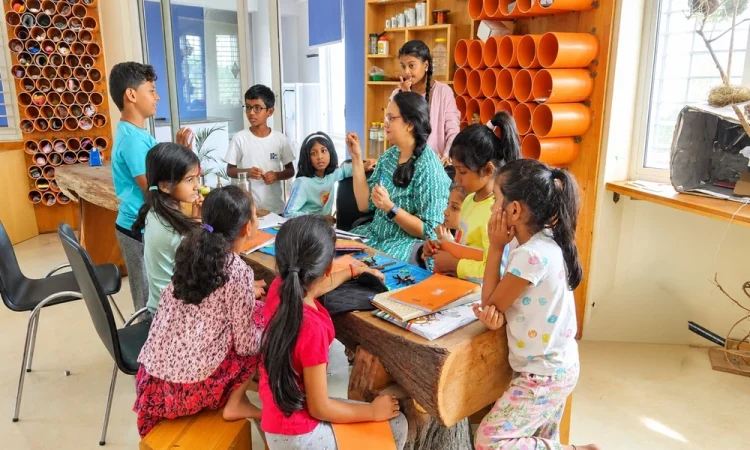
The colony was a group of eight- and nine-year-olds at Blue Blocks Montessori School in Hyderabad, imagining themselves as meerkats in a story-based activity about how animals organise themselves. In one session, they invented a trainer meerkat who could help younger lookouts learn their responsibilities. In another, nine- and ten-year-olds proposed placing two or three sentinels on watch at once, each alert to a different predator.
Nobody gave them the words distributed surveillance or accountability. They were given a problem they could enter, discuss and try to solve. The sessions are described in the school’s Meerkat Model of Bio-Leadership, a 2026 practitioner-led pilot study.
How does Montessori Primary foster independent thinking?
It starts with the gift of uninterrupted time.
Most schools say they do projects, but often that means a chart or model built at the end of a unit, after the teaching is over. Project-based learning in primary schools can turn that order around, so that investigation becomes one of the ways a subject is understood rather than something children do once the learning is finished.
In the Montessori Elementary years, the morning is not cut into forty-minute periods. It is a long, protected work cycle. It may begin with a short presentation to a small group, such as a new idea in mathematics, a story about early humans or an experiment with magnets. The children then take up their work, individually or together, and the guide returns when another presentation or a nudge is needed.
Maria Montessori described a temporary lull in concentration partway through a long work period, which she called false fatigue. She observed it in younger children in the Children’s House, where the restlessness often passed and gave way to deeper, calmer work. It raises an important question for the Elementary years: what becomes possible when work is not interrupted every time attention dips? A timetable that rings a bell every forty minutes rarely gives children the chance to find out.
Where mathematics, language and geography fit in
Parents often ask whether making leaves enough time for academics. In Montessori Elementary, projects do not replace mathematics, geometry, language and geography. They are what make the projects possible.
During the meerkat investigation, one child designed a multi-level burrow with a lift, a predator trap and a playground for the pups. A design like that opens a door to mathematics. How much space would each level need? Could the child draw the burrow to scale? What measurements would a working model require? A guide can introduce these questions so that geometry connects with the child’s own idea instead of arriving as an unrelated exercise.
Language matters just as much. In a research journal, children describe observations, record attempts and explain what they will try next. Writing becomes a tool for making thinking clear, not only a skill to be practised for its own sake.
What kind of projects do students do at Blue Blocks Primary?
Inside this uninterrupted morning, the role of practical learning in primary education becomes visible. Because children aged six to twelve share one mixed-age community, a seven-year-old may become curious about the work of a ten-year-old, while the older child gains a chance to explain, and sometimes reconsider, their own ideas.
The meerkat challenge is one example. On another morning, the same children might be tending the garden after a small-group lesson, preparing a timeline of early civilisations or writing to an expert to ask a question their books could not answer.
Not every investigation must produce a device. A map, an argument, a letter or a revised explanation is meaningful work too. Direct practice in mathematics, reading and writing remains part of every day.
Assessing without marks
This approach naturally raises a question for parents: without traditional exams, how does anyone know a child is learning?
The meerkat sessions offer an answer. The most revealing moments were not the finished burrow designs but actions a written test would struggle to capture. The first was planning. When the challenge cards appeared, groups had to decide where lookouts should stand, whether one was enough and how the colony might protect itself. The second was repair. In one recorded round, children crouched at the wrong signal, and two of them noticed the mistake and helped revise the signalling rule for the next round. The third was explanation. In a design discussion, one child imagined a teacher meerkat who would be “silent and present” so that young meerkats could learn by watching.
None of this proves long-term gains, and the nine-session pilot did not set out to measure them. What it shows is the kind of evidence a guide looks for: whether a child can plan a next step, recognise and fix an error, and explain an idea to someone else.
At Blue Blocks, guides keep records of each child’s work, alongside work journals, portfolios and one-to-one meetings. They ask which concepts a child can explain, what the child can do independently and which presentation is needed next. A beautiful model is not proof of understanding, and a collapsed one may reveal valuable reasoning.
Finding the right campus
For parents comparing any experiential learning school Hyderabad has to offer, the real test is how much of the day children spend investigating, questioning and working, rather than only listening.
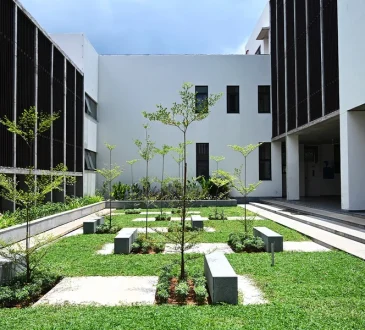
Blue Blocks Montessori School runs Classes 1 to 6 at its Tellapur campus, where the Elementary environment and innovation spaces are based. Families looking for a primary school near Gachibowli can begin closer to home, at the school’s Gachibowli campus, which houses the Toddler Community and the Children’s House for Nursery, PP1 and PP2, before children move to Tellapur for Class 1.
When visiting any school, ask how children choose their work, how guides track progress and what happens when an investigation becomes difficult. The daily structure matters more than the projects displayed on a wall.
Frequently asked questions
Does project-based learning cover the full syllabus?
It can, when a school deliberately maps lessons and independent work against the knowledge children need. At Blue Blocks, Montessori Elementary covers mathematics, language, geometry, geography, history and science through presentations, materials, practice and connected investigations. Projects are one important part of that work, not a substitute for a coherent curriculum.
How will my child adjust if they move to a conventional school later?
Children who are used to planning their own work, keeping records and explaining their reasoning usually carry those habits with them. The main adjustment is often to timed tests and fixed periods, and families can ease it by practising short timed tasks at home in the months before a move.
How can I assess my child’s learning at home?
At the end of the day, ask what your child is working on, what surprised them, or what they want to investigate next. Listen for the reasoning, not only the answer. Interest alone is not a complete measure of learning, but it often points to where real understanding is forming.
Are projects done individually or in groups?
Both. Some investigations begin with one child’s question and stay individual, while others grow into small-group work when classmates are drawn to the same problem. Learning when to work alone and when to work with others is itself one of the skills the Elementary years develop.
The question behind the project
A project is only as valuable as the thinking it demands. The meerkat colony never needed a perfect alarm system. It needed children who could notice when the system failed, and care enough to fix it.